Third Night of Hanukkah

“One who destroys a life, Jewish tradition tells us, is considered to have destroyed the entire world; one who saves a life has saved the entire world. A person is not a statistic, or a unit of GDP, but a boundlessly precious being who has an entire universe of potential. This may seem obvious, but how many of us have walked right by a homeless person on the street who asked for our help? If that person had been a celebrity, would we have stopped? If we had seen a laptop lying on the street, would we have stopped?”

–8 NIGHTS, 8 JEWISH VALUES: REFLECTIONS FOR CHANUKAH ON THE JEWISH OBLIGATION TO BUILD A BETTER WORLD, Sarah Hurwitz

This principle–that of the absolute and nonnegotiable worth of absolutely every human life–must be seared upon our hearts.

We are terrible at accounting, aren’t we?

When we assess worth, much like yesterday’s reflection where we assessed worthiness, often we start from what we feel is a neutral place, and then ascribe debits and credits and come up with a number. Is she a teacher? 3 points. Are they addicted to a substance or engaged in a behavior we don’t like? Negative 6 points. Are their teeth even? Plus 1. Do they smell? Minus 10. What’s their zip code? Do they own or rent? What was their class ranking? And on and on and on.

This needs to be confronted, dismantled, and thrown in the waste bin. Our worth, your worth, my worth, the worth of the Other, starts at Infinite, and never wavers.

We say we know this. It’s embedded in documents that founded this country. It rolls so glibly off of the lips; and is mindlessly belched out without our fully grasping and internalizing the enormity of what it is we are affirming.

Because this is not how the world has taught us to live. We mouth it, but we don’t believe it ourselves–we don’t believe it, even about ourselves. Which is why we so often lead with the attributes we feel will buttress our own ledgers: our education; our achievements; our clothing; our cars. We know we are being sized up, however unfairly, and feel that we come up wanting.

We live in constant anxiety about what is written in those ledgers by the hundreds of people we encounter in the course of a day. And in spite of, or even because we know the game is toxic and rigged, still we impose the will and the weight of those judgments upon ourselves, and our intolerable shame moves to a faux grandiosity, and we do the same to others.

We know we will end up in the red–the system guarantees it. We feel powerless to change what feels like indelible red ink staining our very souls, and so the best we can come up with is that even as we live in deficit, our small measure of comfort is that there are others whose books look worse than ours. We make damn sure of it.

And so it continues.

When I hear Hurwitz speak to the infinite worth of every human, I must start with myself. I must declare myself enough–not perfect, not unteachable, not grandiose, not static and fixed.

I know there is more on the daily that I must do to become just a bit closer to the person I say that I  want to be. I know there is more to learn and unlearn, more to examine, more to practice. But I strive to do it not from a place of lack, but from a place of abundance. I need to get to a place where I can affirm my messy humanity as I look at my crooked teeth, and my legion of moles, and my round belly, and my educational gaps, and my relational challenges, and my failures, all of which make me who I am, and all of which must be accepted and integrated as I prepare to truly meet the Other.

The Other, in their messy imperfect, absolutely perfect humanity.

I challenge myself to look past societal markers; the designer shades, the German horsepower parked in the valet stand that so many of us see as a proxy for value and worth. My smile must be no more bright for those with the keys to the Audi Quattro as for our homeless fellow on Broadway in Lemon Grove.

As we pivot to race we can and do confront other markers that society ascribes warped values and inflated and deflated scores. Pedigree, heritage, clubs, associations, rap sheets, credit scores. All affected by a system of supremacy that puts a fetid thumb on a scale created for the benefit of only a few, to the detriment of so many more. People on the wrong side of that particular slash start with a deficit that no point system can ever make even–the societal forces guarantee that too.

We will never get it right if we use the world’s accounting system.

So it is our task to burn the ledgers–no more credits. No more debits. No more extra credit or asterisks or caveats.

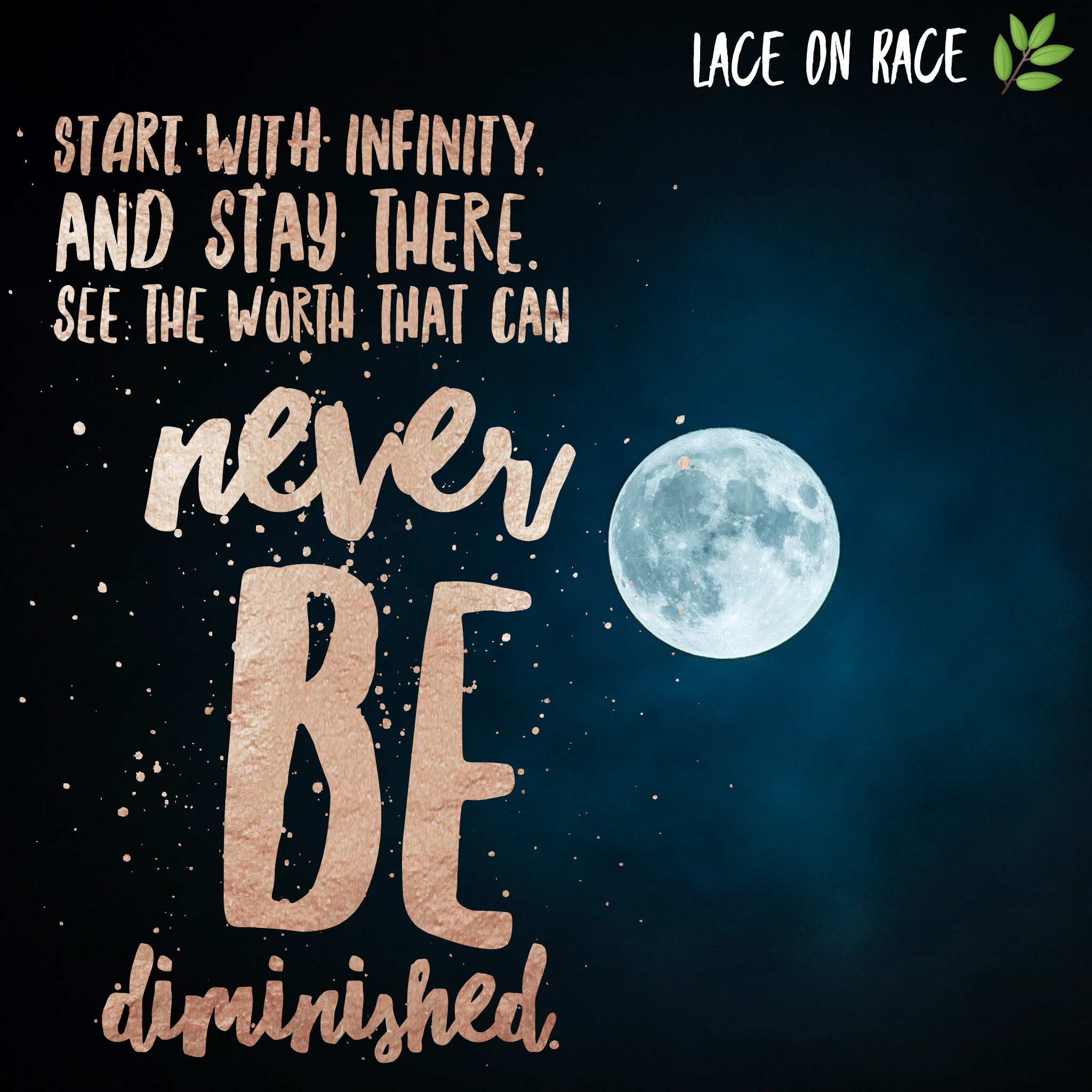
Start with infinity, and stay there. See the worth that can never be diminished. Find what has always been there, in yourselves, and then assist and witness the infinity of the Other. Make it your life’s work.

And the moon rises on the Third Night.


8 responses to “Third Night of Hanukkah”

  1. Shannon Brescher Shea Avatar
    Shannon Brescher Shea

    “When I hear Hurwitz speak to the infinite worth of every human, I must start with myself. I must declare myself enough–not perfect, not unteachable, not grandiose, not static and fixed. … But I strive to do it not from a place of lack, but from a place of abundance.”

    Rejecting that perspective of coming from a place of lacking – especially lacking time and energy – and replacing it with a perspective of abundance is both so hard and so necessary for me. The idea that there is enough for everyone – including me – is so important. And the idea of lacking underlies so much of our individual and systemic prejudice, especially around race. “If those people have more, won’t I have less?” underlies every time white people fight to hold on to a little bit of our power and privilege. But the fact is, there’s plenty in the world as long as we’re willing to see every person’s humanity.

  2. Vicki van den Eikhof Avatar
    Vicki van den Eikhof

    Always already worthy. Always already loved. This is how I need to approach everyone I meet. This is how I need to feel about myself (before I can feel that toward others). I heard someone ask the question: What choices in your life would you have made differently if you knew that you were always already loved? When I see others and feel to judge them, I can instead approach them with the idea that they would do things differently if they knew that they were always already loved-and how can I help them feel that love? Being filled with that kind of love is something I actively seek and pray for. And I have thousands of opportunities each day to experience that love-if I’m paying attention, and willing to set my ego aside. (Cross-posted on FB)

  3. Amanda Lynn Avatar
    Amanda Lynn

    I think I’ve spent much of my life trying to prove the worth that I already have. I think about the ways I interact, the questions I ask of others, and what they ask me upon first meeting. What do you do for a living? Where do you live? Where did you grow up? And how much of those questions are fueled by connection versus sizing up? I think about the ways we justify horrible, terrible things by belittling the worth of another. The solution is presented so clearly, so I will work to “start with infinity and stay there” with myself and others.

  4. Deanna Avatar
    Deanna

    I will be cross-posting this comment on Facebook.

  5. Deanna Avatar
    Deanna

    Wow. Valuing myself full stop so that I can value others is a radical proposition. Especially if you are asking me to value _all_ of myself so that I can value _all_ of others. I’ve been thinking about how to embrace my mental health issues and realized I assume that there are many things I can’t do because of them. But I realized I can be everything that I am at the same time, and that includes all of my strengths as well as my weaknesses and vices. One doesn’t negate the other. They just are; they exist. So I’m not off the hook for loving myself or others just because I have many faults. I’m not off the hook for doing the things I _can_ do just because there are certain things I can’t.

  6. Emily Holzknecht Avatar
    Emily Holzknecht

    I struggle with the ledger. I am sure anyone who has read my comments for a length of time has seen me again and again talking about my struggle with the ledger, in particular with my past of making choices based on what others will think and trying to choose by the North Star now instead of by the ledger. Even though I talk most about me thinking what others will think of me, that is an indicator of an internalized view of the world through a ledger and one that I must be applying to others, as much as I wish I could say that I’m not.

    I think at various points in time I have tried to escape the ledger, but what I was really doing was trading one ledger for another. I was not burning the ledger as Lace asks us to do. And trading one ledger for another was an illusion of change. It’s all the same regardless of what company’s name is scrawled at the top. (Here “company” is meant to sound corporate, but actually refers to the company I keep that influences which ledger I am trading in for.) I can conceive of the idea of burning a ledger, but I am not sure how to get there yet. I will be following Lace’s prescription for service regardless of mental calculation to help me get closer to burning the ledger.

    crossposted

  7. Christin Spoolstra Avatar
    Christin Spoolstra

    As I read through these reflections on the 3rd night, I find myself thinking of the accountants on The Good Place, particularly in regard to this paragraph: “We know we will end up in the red–the system guarantees it. We feel powerless to change what feels like indelible red ink staining our very souls, and so the best we can come up with is that even as we live in deficit, our small measure of comfort is that there are others whose books look worse than ours. We make damn sure of it.”

    The system, one which we still claim is built on the foundation of equal creation, is rigged. And these perverted, contrary adaptations come into play: one where I feel the weight of these judgments on myself and doubt my own value; another where I will twist and maneuver to score more “value points” than the person standing next to me. Both are life and society destroying. Both are true at the same time.

    And that has me thinking about the pivot and the internal and external. Because a lot of these value structures are embedded in white supremacist culture and are part and parcel with the continuation of racism and racist policies. We set a judgment on the value of the human life and write exclusionary clauses all through it. It’s why we can’t get housing or health care or child care.

    So I start to learn to throw out the world’s ledger (the internal work): “I know there is more on the daily that I must do to become just a bit closer to the person I say that I want to be. I know there is more to learn and unlearn, more to examine, more to practice. But I strive to do it not from a place of lack, but from a place of abundance.” And I harness that into the world (the external work) at the personal, relational level as well as as the political and social acts level.

  8. Rebecca McClinton Avatar
    Rebecca McClinton

    ‘Assessing worth’ can be so automatic, and I like how Lace pointed out here how we often start in what we feel is a neutral place. Assuming of myself that I’m starting in a neutral place (when I’m likely not) immediately puts me in a power-over position in an interpersonal interaction.

    I’m also considering labels and how they are used so much to harm in so many forms that follow people harmfully throughout life and become huge barriers in accessing the very things needed to heal (diagnosis or legal labels for example).

    This also helps me reflect on the importance of not going down into shame and abusing from that position. I’m still wrestling with when humility, openness, vulnerability then starts to turns into being offensive through shame and self-preservation, and identifying that quickly and deftly.

Leave a Reply

Your email address will not be published. Required fields are marked *